Osmanthus Cake
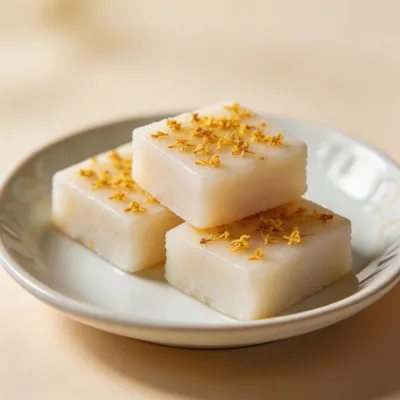
Quick Info
- Flavor
- Delicately sweet with an elegant floral fragrance from osmanthus blossoms. Light and refined, never cloying.
- Texture
- Soft, slightly sticky, and springy — similar to mochi but firmer
- Spice Level
- Not spicy
- Temperature
- Room Temperature
Ingredients
The Story
Osmanthus trees bloom in autumn across southern China, filling entire neighborhoods with their intoxicating honey-sweet fragrance. For centuries, the tiny golden flowers have been harvested and preserved in sugar to use in desserts year-round. Osmanthus cake is one of the oldest and most refined Chinese confections, associated with scholars, poets, and the elegance of Jiangnan culture. In Nanjing and Hangzhou, it remains a signature local treat.
What to Expect
Small squares or rectangles of a pale, semi-translucent cake, sometimes speckled with tiny golden osmanthus petals. The texture is soft and gently chewy — it yields easily to the teeth but has a pleasant springiness. The flavor is subtle: a mild sweetness followed by a wave of floral perfume that lingers on the palate. It is one of the most elegant and understated Chinese desserts.
Tips
Best paired with Chinese green tea, which complements the floral notes. Look for freshly made versions at traditional bakeries and scenic area snack stalls rather than packaged supermarket versions. Osmanthus cake is popular in autumn around the Mid-Autumn Festival but available year-round in Jiangnan cities.